Integrated Master Environmental Engineering
Integrated Master Environmental Engineering


Training for a meaningful career
Are you passionate about environmental issues and interested in becoming an environmental engineer to help protect the planet for the long term? Our engineering program prepares you to work in the fields of environmental engineering, water engineering, environmental science, and sustainable development.
For over 30 years, UniLaSalle Rennes has been training environmental and sustainable development engineers with comprehensive expertise. Through their mastery of science, tools, and methods, they help reduce the impact of human activities by promoting resource efficiency, eco-design, and ecological engineering.
The expertise of environmental engineers lies at the intersection of science and management. Chemistry, biology, statistics, as well as economics, CSR, law, and environmental regulations...
Engineers recognized for their comprehensive understanding of the environmental field, trained to support both businesses and local communities and meet their needs. Agile engineers who will be able to adapt to regulatory and societal changes to support these transitions.
Here, after two years of undergraduate studies and a 6-month international experience (Go LaSalle), you can choose between one of our three career tracks. A training format designed to give you time to develop your career plan and ensure you have every opportunity to choose the combination that will allow you to thrive.
Your role?
The program
3 career paths
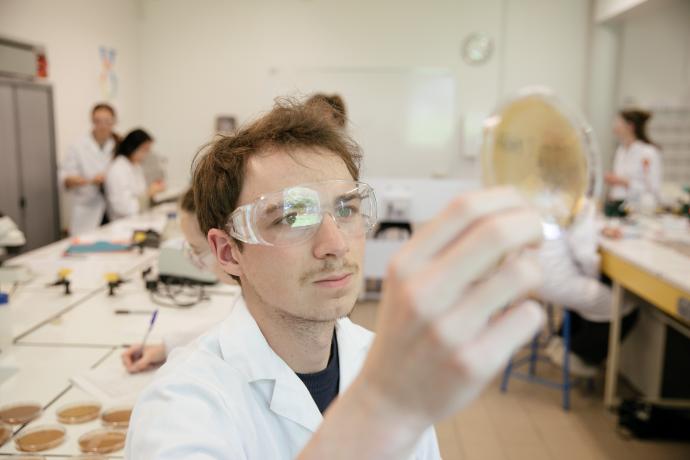
- The only general engineering program 100% dedicated to the environment
- 360° expertise thanks to a multidisciplinary curriculum
- Research projects commissioned by partners (companies, NGOs, local governments, etc.)
- Integrated professional certifications: BCorp auditor, Sulitest, carbon footprint assessment, etc.
- EkoLab, our low-tech fablab for carrying out your projects
- Program available as a work-study program and through continuing education leading to a degree (RNCP listing)
Admissions & Applications
Post-baccalaureate applicants
The Food Science & Health Engineering program is available to high school graduates through:
Parallel Admission Applicants
| Admission to the 2nd year of the undergraduate program | Admission to the engineering program (3rdor 4thyear) |
|
|
International applicants
For applicants with an international degree, applications can be submitted through Campus France or directly on the UniLaSalle website.
Practical Information
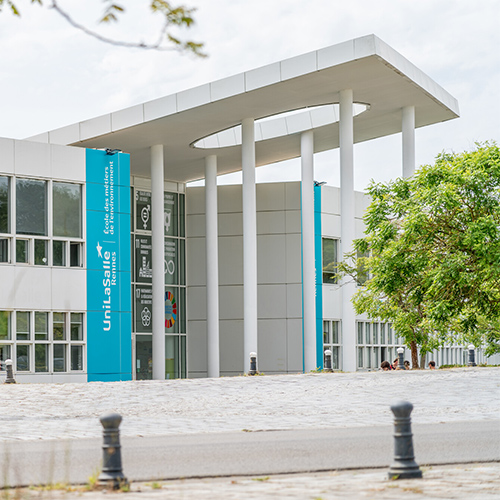
The Rennes campus
A campus dedicated to the environment, at the heart of the Ker Lann campus and a city committed to sustainable development
- A pleasant, natural environment with excellent public transportation access
- Services at the Ker Lann campus: housing, dining (including CROUS), sports facilities, medical services, and more
- A friendly campus with 16 schools and 60 companies, where students form one big family
- The rich cultural and athletic life of Rennes
How do I get there?
Getting here by train:
Daily TGV service to Rennes from Paris
Daily TER service from Rennes Station to the Ker Lann campus (Ker Lann Station) via Line 15
Getting here by bus:
The campus is served daily by bus lines C7 and 219, as well as the N3 night bus (Ker Lann stop).
Getting here by car or bike:
UniLaSalle Rennes: Ker Lann Campus – Avenue Robert Schuman – 35170 BRUZ
GPS coordinates: 48.04418, -1.74579
Tuition fees for 2026–2027
- IUndergraduate program: €7,500/year
- Integrated Master program: €8,200/year
- Engineering apprenticeship program: covered by the company
- Campus fees: €520/year
Financial aid
Various financial aid options:
- CROUS grants based on financial need
- Grants and interest-free loans from the Jean-Baptiste Gagne Foundation
- Scholarships (covering 20% to 100% of tuition for students receiving grants based on financial need)
- Interest-free student loans
- Support for international mobility
FAQ
Why study environmental engineering in Brittany?
Studying in Brittany means pursuing a degree in environmental engineering in the heart of an exceptional region, renowned for the richness of its ecosystems “between land and sea.” This region offers an ideal learning environment to become an environmental engineer, thanks to the diversity of its challenges: water quality, coastlines, biodiversity, sustainable agriculture, renewable energy, the circular economy…
Located in Bruz, within the Rennes metropolitan area, our environmental engineering school fully benefits from this privileged setting: at the crossroads of marine, rural, and urban environments, Brittany serves as a true open-air laboratory for developing skills in water engineering, ecological engineering, environmental engineering, and environmental management and sustainable development.
From wetland conservation and water resource management to coastal issues, soil quality, and the energy transition driven by renewable energy, students have access to a rich, practical, and diverse field of study. This immersion allows them to gain a direct understanding of current environmental challenges and to prepare for careers as water and environmental engineers, ecological engineers, environmental engineers, or specialists in environmental engineering applied to regional contexts.
Brittany is also a region committed to innovation: competitiveness clusters, laboratories, specialized companies, and public stakeholders work together to address environmental challenges. Our students fully benefit from this dynamic, as they are regularly involved in real-world projects alongside industry professionals.
Studying in Brittany means choosing an environmental engineering school located at the heart of a pioneering region, where nature, the ocean, and human activities coexist and reinvent themselves. It is an ideal setting to develop solid, real-world expertise and become an environmental engineer capable of taking action and innovating.